


 :info@hutongglobal.com
 :hutongglobal
 About Us
Wollastonite for glass fiber and ceramic fiber |
|
 |
|
Item : |
|
Details :Wollastonite for glass fiber and ceramic fiber
Application of wollastonite to glass fiber and ceramic fiber industry
CaO is one of the main components of E glass as a network modifying oxide of the glass structure. It is mainly used as a stabilizer or melting flux that accelerates the hardening of fiber when the glass structure is formed and improves the quality of the glass fiber. SiO2 is the most important component of E glass. It is the forming body of glass and the base for almost all glasses. When oxidized silica is heated to liquid and then cooled, glass is formed。
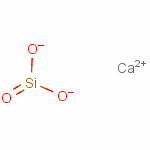
The main components of wollastonite are SiO2 and CaO which represent at least 96% of the content of wollastonite. Other components include a lesser amount of magnesia, alumina, ferric oxide and other oxides which are all required for making glass. Wollastonite is used in glass to incorporate the part of silicon oxide for forming glass that is not supplied mainly by means of pyrophyllite, i.e. in place of all arenaceous quartz, since the latter is melted at high temperatures and does not soften until the temperature has reached higher than 2000°C. Another problem is that arenaceous quartz is very hard, as hard as 7 minimum, and often contains particles larger than 250μm when it is processed into micron powders smaller than 45μm. So it is not possible that all coarse quartz particles unnoticed in the raw materials will be melted when glass is passed through the funnel of the baseplate and these particles will often cause a break in the glass。
Moreover, wollastonite is itself a fluxing agent, SiO2 and contains the compound form easily with other oxides chemical reactions occur, and wollastonite hardness (4-5) than quartz sand hardness (7) small, easy processing. Wollastonite SiO2 while the glass molding, into the part of calcium oxide, can be in the glass with limestone decrease the amount of material, due to the reduced amount of limestone decreases with the compound CO2 volatilization, can not only enhance the glass conversion rate, and reduce the emission of flue gas in the furnace, the furnace to reduce heat consumption.
It is fully possible to use wollastonite in the raw material for producing glass fibers. As wollastonite itself adds to melting and composes of silicon and calcium oxides, it largely reduces carbon emission, replaces silicon oxide, reduces the melting temperature of glass and mitigates the consumption of natural gases. The part of calcium oxide incorporated increases the melt rate by 1-2%.
|
|
 |
[Next] [Previous] |
|
