


 :info@hutongglobal.com
 :hutongglobal
 About Us
Solid Cationic Etherification Agent |
|
 |
|
Item : EPTAC cas 3033-77-0 |
|
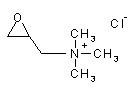
Details :Chemical Name: Solid Cationic Etherification Agent (EPTAC)
English Name: 2, 3-epoxypropyl trimethyl ammonium chloride CAS No.: 3033-77-0 EINECS: 221-221-0 Molecular Formula: C6H14ClNO Structural Formula: Molecular Weight: 151.5
Melting Point: 140°C Character: White solid at room temperature Content: ≥95% Impurity: ≤250ppm (epichlorohydrin) Use: EAT has a wide range of uses. It can react with many ground substances, such as starch, cellulose, guar gum and polyacrylamide and produce a variety of substances, which are widely used in paper industry, commodity chemical industry, petroleum industry, water treatment industry and other fields. Storage: Sealed and stored in a cool and dry place Package: Plastic woven bag or paperboard cask, 20 or 25 kg per bag. EPTAC is a fine multifunctional chemical product. Its chemical name is 2, 3-epoxypropyl trimethyl ammonium chloride (ETA). It is white solid at room temperature, soluble in water easily and will dissolve when absorbing moisture from air. Its molecular weight is 151.5 and melting point is 140°C.
ETA molecule contains quaternary ammonium group and epoxy group. It reacts easily with compounds containing active hydrogen and can generate multifunctional chemicals with quaternary ammonium group. There is no need to add alkali or a little for catalysis. So it has little by-products and simple process operation. The ETA researched by us has the following features: (1) High purity, with content of 95% or above (2) High reaction efficiency with starch and other matrix, the reaction rate can reach 100% under optimized conditions. (3) Small molecular weight, the dosage is only 80% of similar products under the same condition. (4) With activity, it is very convenient to use. (5) Cationic starch produced by it with active etherifying agent has less corrosion to paper machine systems. EAT has a wide range of uses. It can react with many ground substances, such as starch, cellulose, guar gum and polyacrylamide and produce a variety of substances, which are widely used in the following industries.
(1) Paper industry ETA reacts with starch directly and produces cationic starch, which can be massively used in paper industry as retention and filter aids, dry and wet reinforcers, surface sizing agents, etc. ETA is not only suitable for professional cationic starch manufactories but also particularly easy to be used by paper factories to produce cationic starch. (2) Commodity chemical industry Quaternary ammonium compound produced when ETA reacts with cellulose is an important conditioner of two-in-one shampoo, which can be applied in various cosmetics, having no irritation and injury to skin and hair, and boasts a good compatibility with other anionic surfactants. Cationic guar gum generated when guar gum reacts with ETA is also an important daily chemical. (3) Petroleum industry The development history of petrochemical science shows: Oilfield chemicals are transiting from the past anion system and non-ionic system to a cationic compound system. ETA can react with a variety of electronegative natural polymers and synthetic polymers and achieve cationic quaternary ammonium modification, thus giving them new capabilities and applications. In the petroleum industry, EPTAC itself is an excellent clay stabilizer. Products generated when EPTAC reacts with other ground substances have a much wider uses in oilfields. Applications of EPTAC can be found in drilling mud, oil extraction agents, oilfield sewage treatment, etc. (4) Water treatment industry
Suspended solids in water present electronegative and cationic polymers are widely used in water purification as flocculants. Compared with inorganic flocculants, organic cationic polymers feature less dosage, fast flocculation speed, less affected by coexisting salts, PH value and temperature, less sludge produced and tractability. Cationic polymer flocculants are the most efficient and most important flocculants in actual applications. Cationic polymers generated when reacting with EPTAC shall be widely used in water treatment industry. ---------------------------------------------------------------------------------------------------------------------------------------------------------- Identification of 3033-77-0
Chemical Properties
Safety Data of 3033-77-0
|
|
 |
[NextCHPTAC] [PreviousDMDAAC cas 7398-69-8] |
|

